
Autism vs Gifted
May 12, 2026

At age four, both giftedness and autism can present with unique and overlapping social-emotional behaviors, which can sometimes cause confusion during early development screenings. Here's a breakdown of the differences in social-emotional behavior between a gifted four-year-old and a four-year-old with autism:
1. Social Interaction
Gifted Child:
-
May prefer the company of older children or adults due to advanced verbal and cognitive skills.
-
May engage in imaginative play with complex storylines.
-
Often shows strong empathy and an ability to read emotional cues (though not always).
-
Might appear "bossy" or intense due to their vocabulary or confidence.
Autistic Child:
-
May prefer to play alone or have difficulty initiating or maintaining peer interactions.
-
Play may be repetitive or focused on specific routines rather than imaginative.
-
May struggle to read or respond to others' emotional cues.
-
Might not respond to their name consistently or maintain typical eye contact.
2. Emotional Regulation
Gifted Child:
-
Can be emotionally intense—with big feelings, deep frustration, and perfectionism common.
-
May experience anxiety if things aren't "just right" or if expectations are high.
-
Can often verbalize their emotions with a surprising level of insight.
Autistic Child:
-
May have emotional meltdowns, often triggered by sensory overload, unexpected changes, or communication frustration.
-
Might not be able to verbalize feelings or understand emotional states.
-
May use stimming (repetitive movements or sounds) to regulate emotion.
3. Communication Style
Gifted Child:
-
Often has an advanced vocabulary and speaks in full, complex sentences.
-
May ask deep, abstract questions (e.g., about time, death, space).
-
Uses language flexibly to connect, persuade, or tell stories.
Autistic Child:
-
Speech can vary: some are highly verbal, others have limited or no speech.
-
Language may be scripted, echolalic (repeating phrases), or overly literal.
-
May struggle with conversational turn-taking or understanding sarcasm/humor.
4. Eye Contact and Body Language
Gifted Child:
-
Typically uses eye contact, gestures, and facial expressions appropriately, though may seem distracted if hyperfocused.
-
Might use body language expressively in storytelling or social connections.
Autistic Child:
-
May avoid eye contact or seem to look "through" people.
-
Gestures and body language might be limited, unusual, or not used to enhance communication.
5. Play and Interests
Gifted Child:
-
Shows creative, elaborate, imaginative play.
-
Interests may seem "intense" but are often wide-ranging and shift over time.
-
Often enjoys puzzles, problem-solving, and building complex things.
Autistic Child:
-
May have highly specific, fixated interests (e.g., trains, maps, letters).
-
Play can be repetitive, involving lining up toys or spinning objects.
-
May struggle with pretend play or symbolic use of objects.
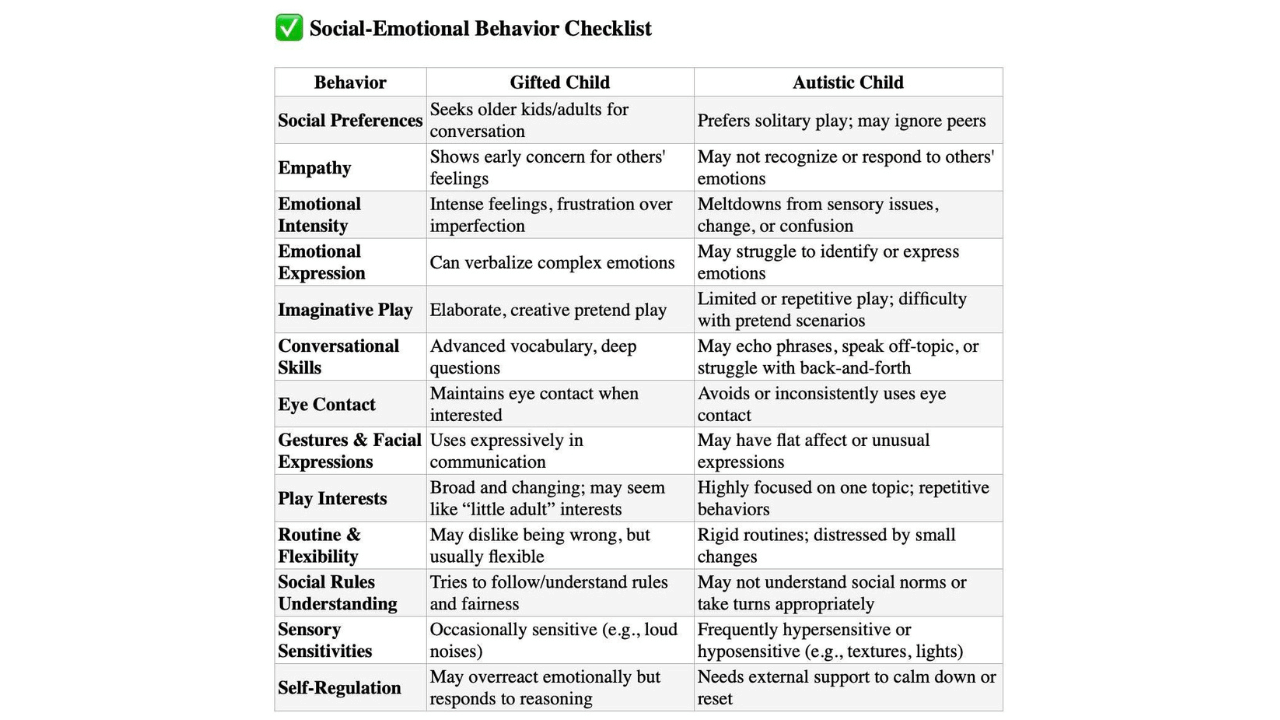
Important Note:
A child can be both gifted and autistic—this is called "twice-exceptional" (2e). These children may have high cognitive abilities but still struggle with communication, sensory issues, or social understanding.
Would you like to learn more about Movement Lesson? Click HERE today!