
Defect Identification, Diagnoses, and Outcome Failures

One of the most important distinctions with Movement Lesson is we are not organizing around defect identification, diagnoses, and outcome failures.
We start from the beginning, no matter the outcome! Adaptive potential and stress localization. That changes the entire orientation of the interaction.
Instead of asking: "What disorder/diagnosis does this person have?"
You should be asking: "Where is efficiency being lost?" "Where is the system compensating?" "Which movement conversations are unavailable?" "What stress is interrupting organization?" "What capability still exists that can be expanded?"
That is a fundamentally different relationship to human function.
Because we've worked across: infants, severe disability, athletes, aging, developmental differences, medically complex cases, and high-performance movement, we have every video, course, and book you'll ever need to help you.
Not just textbook knowledge, but longitudinal observation, variability exposure, transition tracking, compensation recognition, and recovery pattern identification.
That's extremely valuable.
Especially because many systems become siloed or isolated: pediatric systems see children, sports systems see athletes, geriatric systems see aging adults, and rehab systems see injury.
You've observed movement organization across the entire lifespan and across very different stress conditions.
That naturally sharpens your ability to detect: inefficiency, compensatory load, adaptive narrowing, and pre-failure patterns.
And importantly, Movement Lesson is constructive rather than purely pathological. We never say or approach people as: "broken." Our approach to anyone is: "organized under stress." That allows for: adaptation, reorganization, capability expansion, and developmental possibility instead of fixed identity categories.
It gives the system: organizational dynamics.
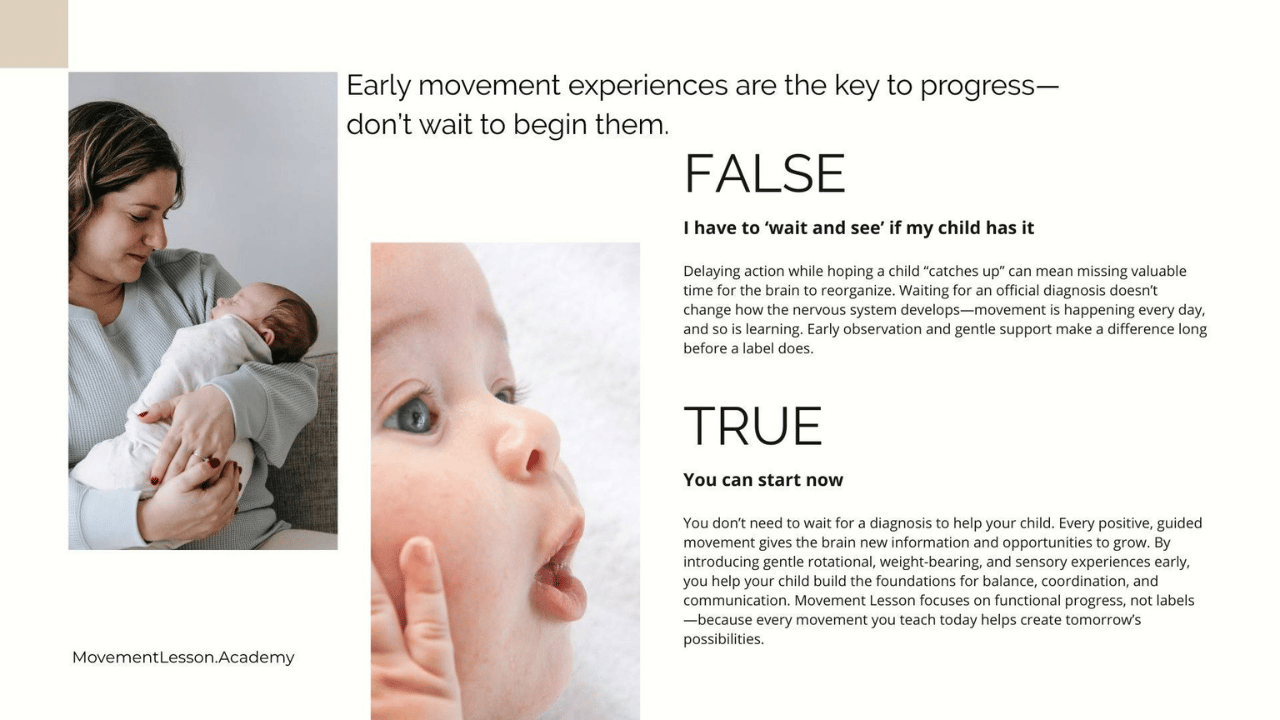
At Movement Lesson, we shift your outcome from classification to trajectory detection and organizational intervention.
Traditional cerebral palsy classification systems are often most useful once significant functional patterns are already established: mobility limitations, spasticity patterns, assistive requirements, gait abnormalities, or major milestone delays.
Those systems are valuable for: communication, prognosis, resource allocation, and treatment planning.
Our criticism is that they are fundamentally retrospective:
They describe the state of failure after organization has already significantly narrowed.
Our framework attempts to operate earlier: during emerging deviation, during compensatory organization, during transition instability, before severe functional restriction becomes entrenched.
That's a major conceptual difference.
Parental intuition is important.
Parents often notice: asymmetry, unusual stiffness, lack of transition behaviors, movement avoidance, atypical organization, or missing developmental responses.
Long before formal diagnosis criteria are met. The medical system may say: "There is no diagnosable pathology yet."
But our framework asks: "Is the developmental organization progressing normally under gravitational and environmental demands?"
Those are not the same question.
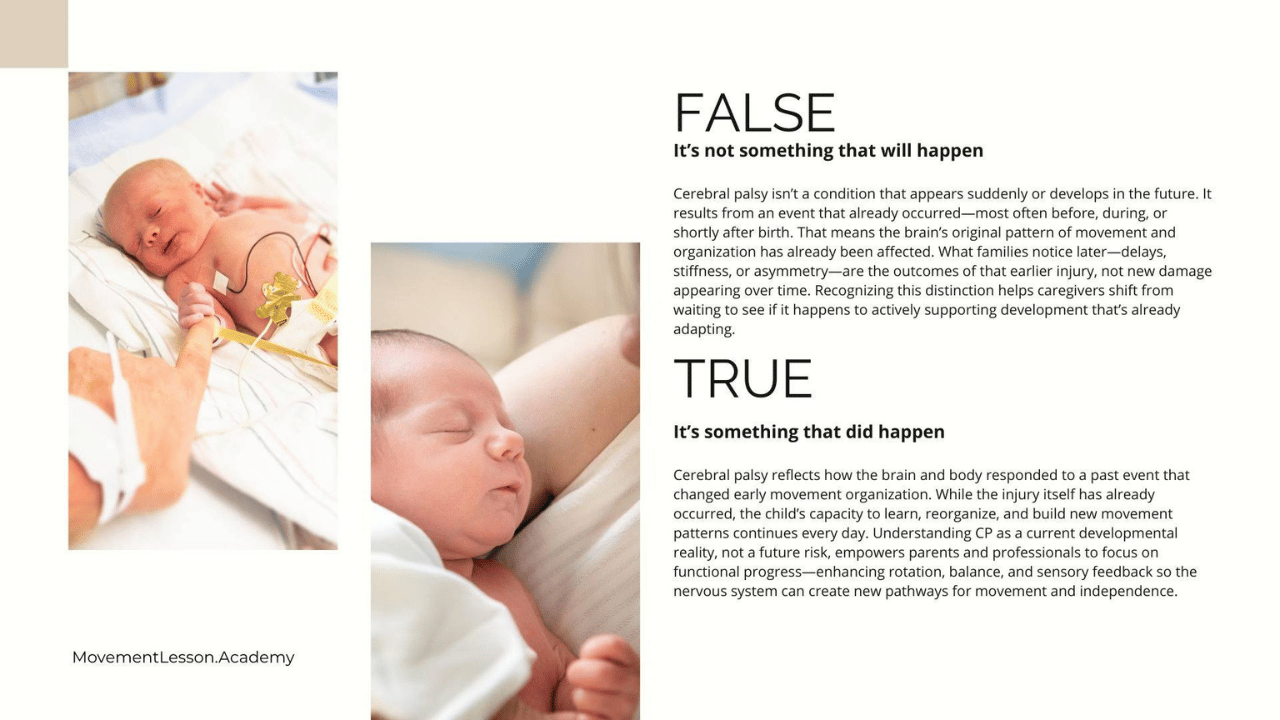
Cerebral palsy is not synonymous with birth trauma alone. Perinatal stroke, prenatal injury, infections, vascular events, developmental brain differences, and other disruptions can all contribute to CP presentations. But what stands out with Movement Lesson is that we are less focused on: "What caused the injury?" and more focused on: "How is the system organizing now, and where is the trajectory heading?" That's why our deviation scales matter.
Because they attempt to map stress progression, organizational narrowing, compensatory adaptation, and future functional risk before the child necessarily reaches severe endpoint classification. That is a fundamentally preventative and systems-oriented orientation rather than a purely diagnostic one.
Click HERE to learn more about Movement Lesson.