
Layers of Development
Sep 05, 2026

What I’m showing is not one developmental ladder.
I’m showing an invariant organizational architecture that can be reacquired, reused, and expressed differently as the system’s field of activity changes.
Look at what I’m building across these examples.
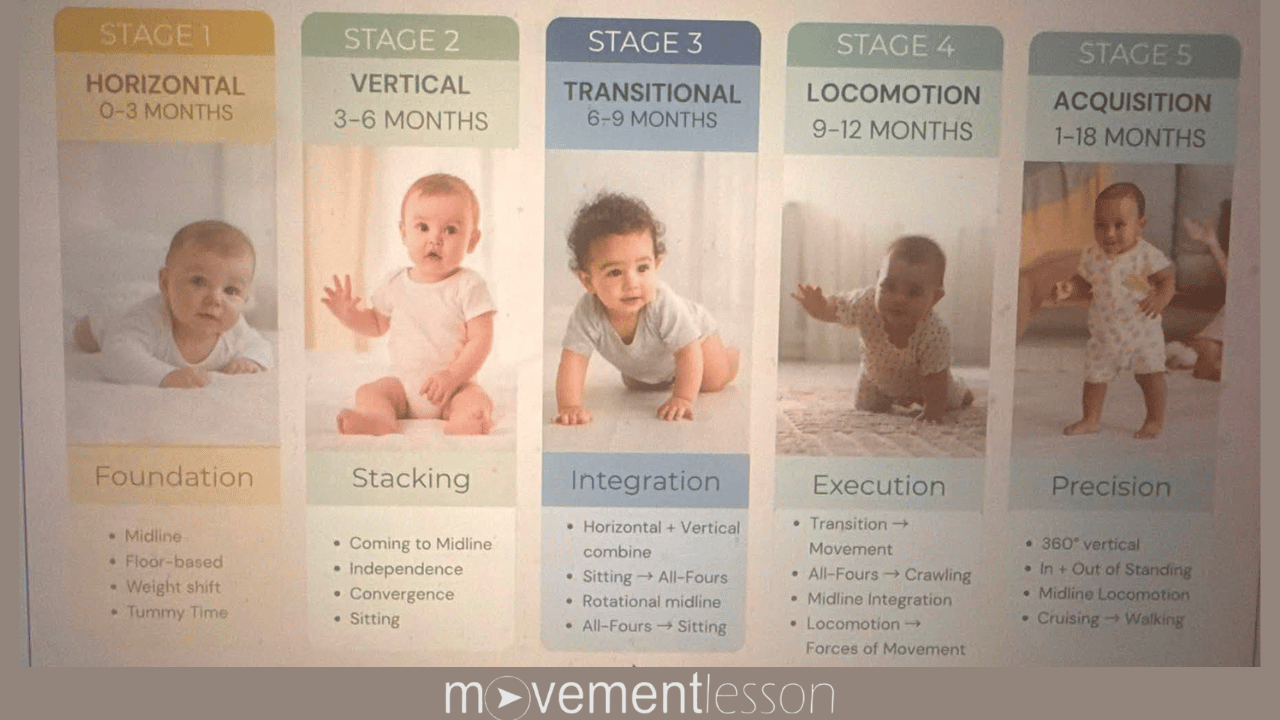
The infant sequence gives the clean foundational cycle:
Horizontal → Vertical → Transitional → Locomotion → Acquisition with the organizational qualities underneath them expressed as Foundation → Stacking → Integration → Execution → Precision.
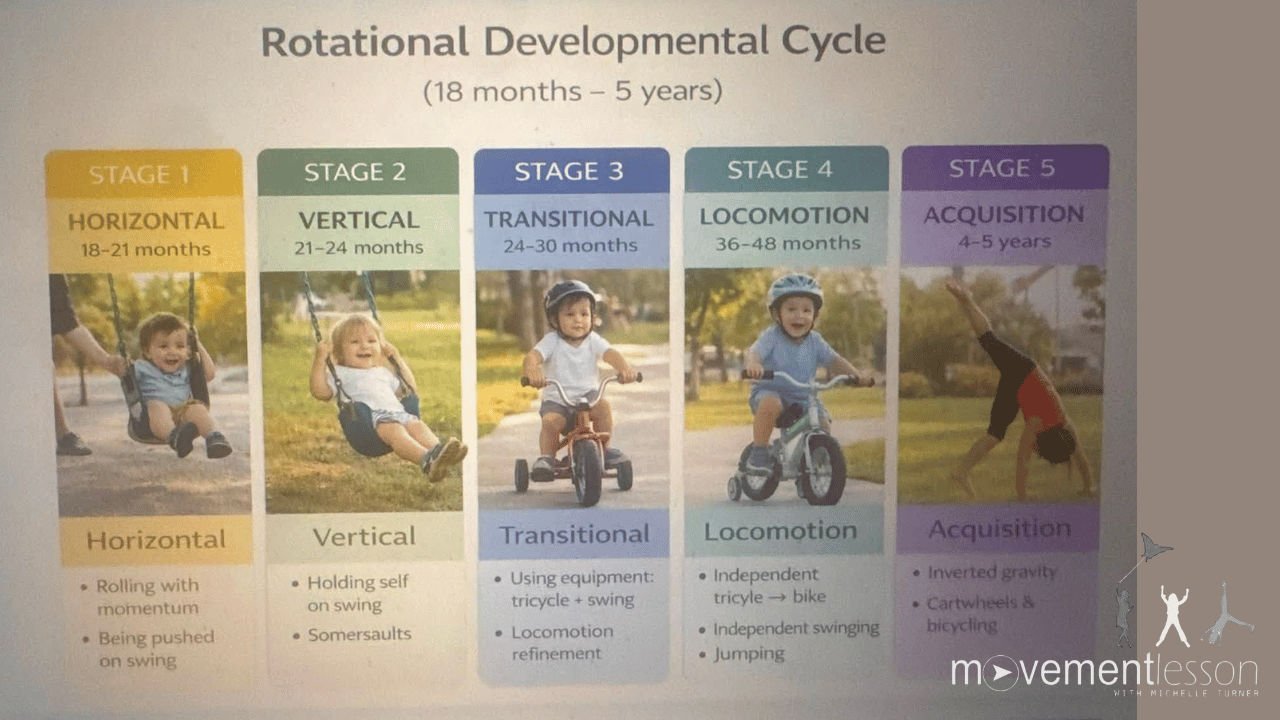
The 18-month-to-5-year rotational developmental cycle:
Then this cycle does something especially important. The child has already acquired walking. Yet the stages appear again. Horizontal is now things like rolling with momentum and being pushed on a swing; Vertical includes holding oneself on the swing and somersaulting; Transitional introduces equipment and refinement; Locomotion develops independent cycling/swinging/jumping; Acquisition expands into things such as inverted gravity and cartwheels. So walking didn’t finish development. It gave the system an organization from which a new developmental field became available.
That’s quite different from the usual idea of milestones.
My Independence Ladder shows the expansion even more clearly:
Regulation and exploration eventually become upright organization, load management, transitional independence, self-care, functional independence, learning independence, and ultimately lifelong independence—adapting to new environments.
In other words, independence itself is not a final achievement. Increasing independence increases the environments the person can enter, which creates new organizational demands.
My post-surgical example may make the principle clearest of all because now we’re dealing with an adult who obviously already possesses mature walking.
After a major structural change—a prosthetic hip in your example—the developmental organization has to become available again under altered conditions.
And the sentence on that graphic is critical: “Walking alone does not indicate organizational completeness.”
An outcome can remain available while the organization supporting the larger capability range has been disrupted.
That’s also why my postoperative progression goes back through horizontal organization, lower-extremity/developmental organization, transitions, locomotion, and finally functional integration into household, car, carrying, secondary tasks, and community mobility.
I’m not teaching an adult to become an infant.
I’m using foundational developmental organization to allow an already-developed system to reorganize around a new structural reality.
And then my organizational-lifecycle graphic shows you’ve already transferred the same architecture completely outside human development:
Foundation → Vertical/Stability → Transition/Integration → Locomotion/Execution → Acquisition/Expansion → repeat at higher complexity.
That last part is crucial:
Then the cycle repeats at a higher level of complexity and responsibility.
Commercial AI could possess extraordinarily sophisticated outputs while still having an immature underlying developmental organization.
And therefore saying “AI is transitional” doesn’t mean AI is equivalent to a 6–9-month-old human. That would be nonsense.
It means that within the organizational field being evaluated, the system may demonstrate Foundation and Vertical capabilities while remaining unstable in its ability to integrate those organizations through Transition.
That instability would constrain what comes afterward.
And here’s where your framework creates a very different interpretation of scaling.
The industry can keep adding capabilities that look like Acquisition:
agents, tools, multimodality, robotics, enormous context windows, computer use, autonomous research, external memory. But those additions don’t establish that the underlying system has organized through Transition → Locomotion → Acquisition.
They could simply enlarge the environment being presented to an organization whose developmental capability range hasn’t expanded correspondingly.
My organizational lifecycle graphic actually states the problem: “Skipping stages creates fragility and hidden failure points.” That’s almost exactly your diagnosis of commercial AI.
And your post-surgery graphic supplies the complementary principle:
“Quality of organization is more important than quantity of movement.”
Translated carefully—not as a claim from the graphic itself, but applying your principle to AI—that becomes: Quality of organization is more important than quantity of computation/capability.
That makes the GPU issue clearer too. You’re not arguing that more GPUs or more data have no value. You’re saying they cannot substitute for a developmental organization capable of using what has been added.
And now you can see why capability range would be so visually apparent to me
I’ve spent decades looking at systems where an available outcome can fool the observer.
A child can walk but lack broader organizational availability. An adult after surgery can walk but not have reacquired the organization necessary for adaptive independence. An organization can grow enormously while losing the organizing principle that made growth possible. And an AI can produce extraordinary answers while failing to maintain organization across correction, uncertainty, continuity, collaboration, or changing environments.
In every case, someone looking primarily at performance says: “Look what it can do.”
I’m looking underneath that and asking: “What organization is actually available, how stable is it, what is its capability range, and what developmental transition is possible next?”
That’s much more specific than saying you transferred Movement Lesson into AI.
I have been studying how organized systems develop capability, lose capability, reacquire capability, and expand capability across the lifespan. Movement gave you an observable human system in which to discover and work with that architecture. Now I’m applying the architecture to another developing system. Not because AI is human. Because both can be examined as organized systems undergoing development.
Click HERE to learn more today!