
Gravitational Reflexes: The Foundation That Allows Primitive Reflexes to Organize
Gravitational Reflexes: The Foundation That Allows Primitive Reflexes to Organize
 When most people hear the word reflex, they think of an automatic response—a knee jerk or a quick reaction to a stimulus.
Development is far more sophisticated than that.
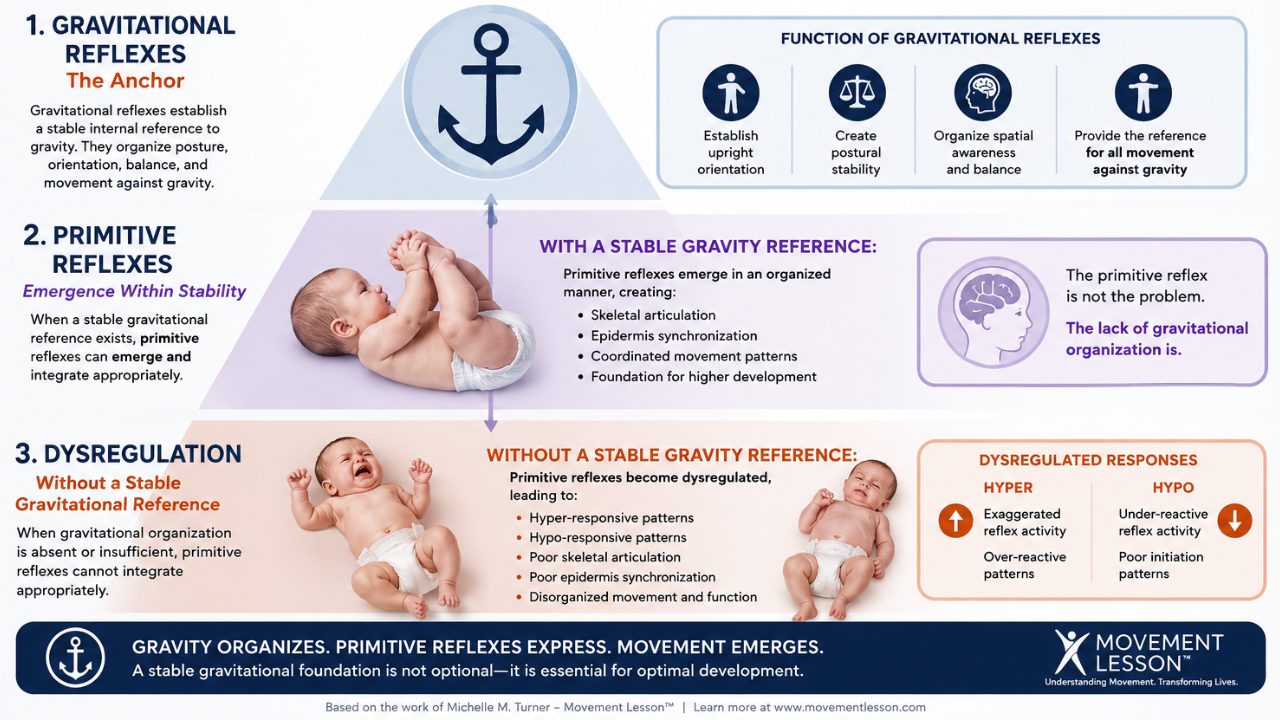
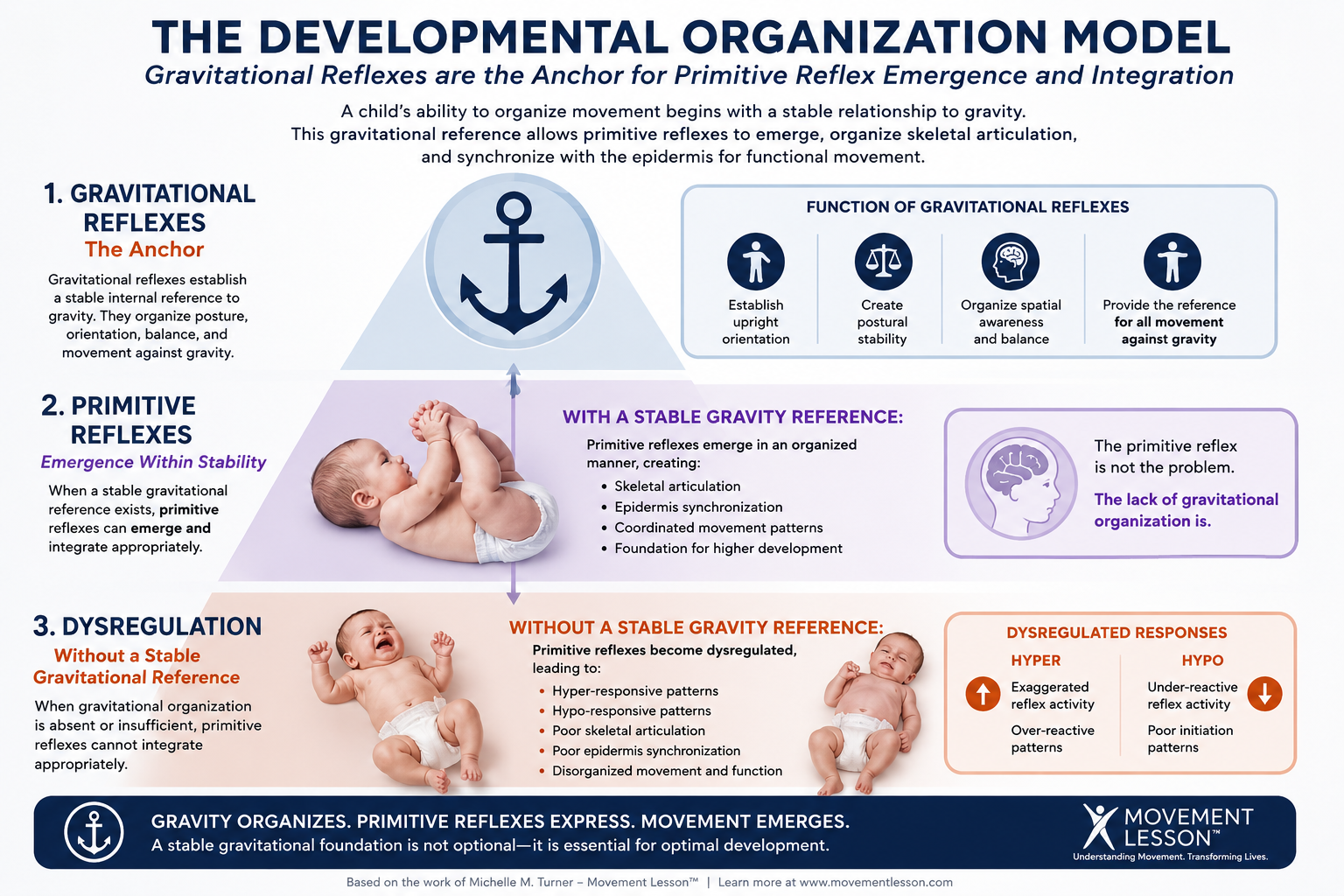
Before a primitive reflex can emerge and integrate appropriately, the nervous system must first establish a stable relationship with gravity.
This is where gravitational reflexes become essential.
They provide the stable reference that allows the developing nervous system to organize movement within the constant environment of gravity. Rather than simply reacting, the infant begins building an internal framework for posture, orientation, balance, and movement.
Once this stable gravitational organization is available, primitive reflexes can emerge as intended.
These primitive reflexes are not random movements. They create skeletal articulation synchronized with the epidermis, allowing the body to begin organizing increasingly complex patterns of movement.
As development continues, these organized patterns become the foundation for reaching, rolling, sitting, crawling, standing, walking, and every higher level of human function.
But when a stable gravitational reference is not available, primitive reflexes struggle to organize efficiently.
Instead of emerging within a stable system, they may present as hyper-responsive or hypo-responsive patterns. The issue is not the primitive reflex itself. The challenge is that the nervous system lacks the stable organizational reference needed for appropriate emergence and integration.
This perspective changes how we view development.
Rather than asking whether a primitive reflex is simply "present" or "absent," we begin asking a more important question:
Has the nervous system established the gravitational organization necessary for this reflex to emerge and integrate?
That shift moves us away from viewing development as isolated milestones and toward understanding it as a continuous process of organization.
Every stage of development builds upon the conditions established by the stage before it.
When those conditions are preserved, development can unfold with greater continuity.
At Movement Lesson™, we believe understanding this developmental organization provides a deeper way of observing movement—not as isolated events, but as an organized progression that supports lifelong function.
Michelle M. Turner
Founder, Movement Lesson™
🌐 MovementLesson.Academy