
Understanding CP and Development
Dec 27, 2025
The 5 Organization Stages of Movement
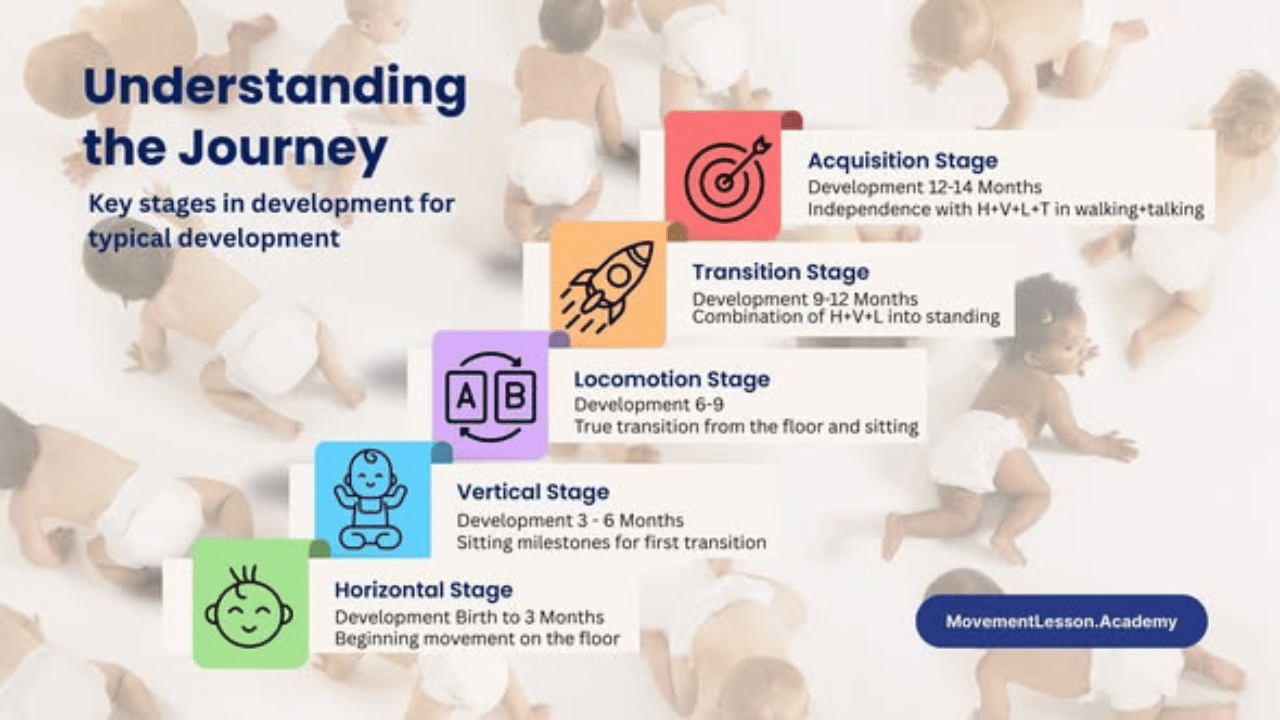
Each stage organizes the body to manage a new level of force, complexity, and intention.
1. Horizontal Organization
The horizontal stage is where movement begins against gravity with the body fully supported by the floor. Here, the nervous system learns foundational force distribution, midline awareness, and sensory integration through rolling, weight shifting, and prone/supine movement. This stage builds the base for postural control and prepares the system to eventually organize movement upward against gravity.
2. Vertical Organization
The vertical stage introduces movement against gravity through supported sitting and early upright control. The child learns to stack the pelvis, spine, and head while managing balance without collapsing or fixing. This stage depends on a successful horizontal base and establishes the stability required for controlled transitions.
3. Transitional Organization
The transitional stage integrates horizontal and vertical systems, allowing the child to move between positions independently (floor  sitting , kneeling). True transitions require rotation, weight shift, and midline stability. This is where many compensations first appear if earlier stages are incomplete.
sitting , kneeling). True transitions require rotation, weight shift, and midline stability. This is where many compensations first appear if earlier stages are incomplete.4. Locomotion Organization
Locomotion is the stage where the child can move through space with control and adaptability, such as crawling, creeping, or early walking. This stage requires the body to manage dynamic forces, alternating limbs, and continuous balance while maintaining midline organization.
5. Acquisition Organization
Acquisition is where movement supports cognition, exploration, and purposeful interaction with the environment. At this stage, movement is no longer the focus — it becomes the tool for learning, play, communication, and skill development. Quality movement allows attention, vision, and intention to work together.
Understanding the Gaps in Stages of Development
Horizontal Complications
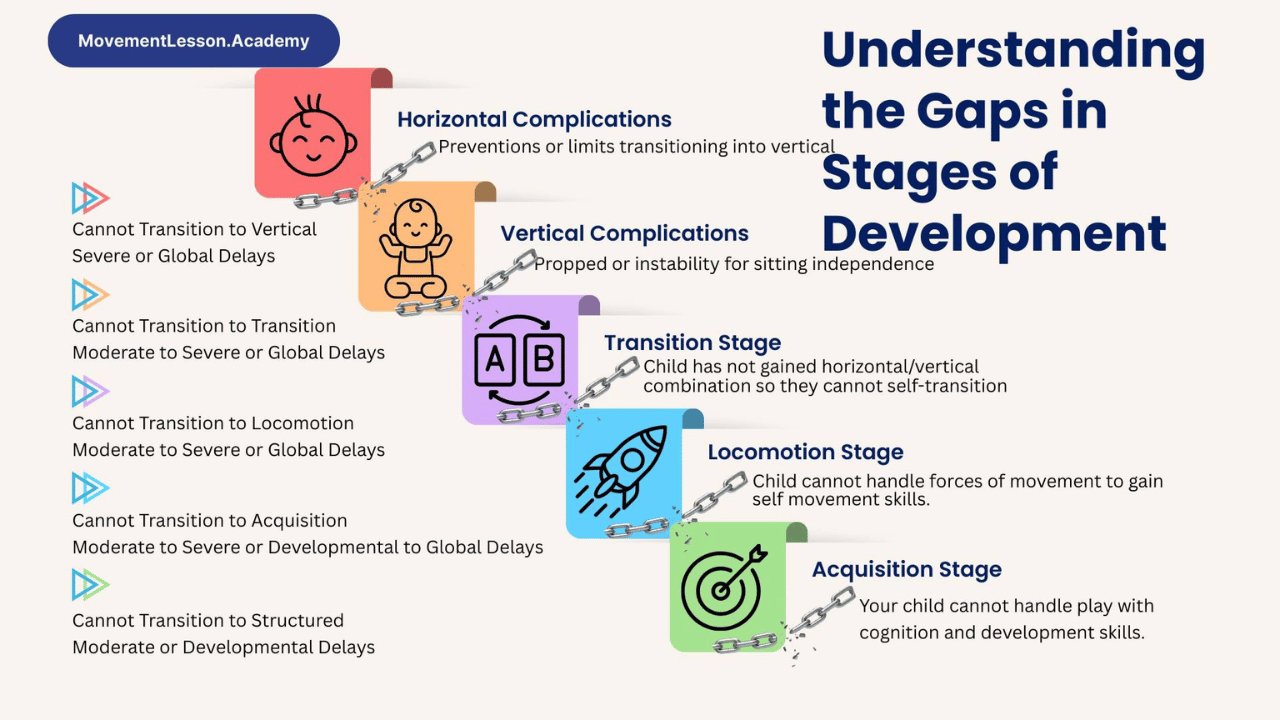
When horizontal organization is incomplete, the child may struggle to develop the force distribution and sensory integration needed to move upward. This limits or prevents progression into vertical control and often presents as global or early movement delays.
Vertical Complications
Vertical complications occur when sitting is propped, fixed, or unstable. Without true upright organization, the child cannot safely or independently transition, often relying on compensatory positions rather than active balance.
Transitional Complications
If horizontal and vertical systems are not integrated, the child cannot self-transition. Movement becomes fragmented, effortful, or avoided, leading to compensations that replace true rotational control.
Locomotion Complications
Locomotion issues arise when the body cannot manage dynamic forces. Instead of adaptive movement, the child may use stiff, asymmetrical, or inefficient patterns that limit exploration and environmental interaction.
Acquisition Complications
When earlier stages are disrupted, movement no longer supports cognition and play. The child may appear inattentive, avoidant, or developmentally delayed, not due to lack of intelligence, but because movement cannot support learning demands.