
Cognitive Vision + Developmental Relationships: Part 1 of 2
Sep 08, 2026

Movement Lesson VISION
Developmental Vision → Functional Organization → Movement Integration
Purpose
To show that visual development is not an isolated sensory achievement and is not adequately represented by whether a child can “see.”
Turner Vision examines how vision becomes functionally organized through development, how that organization participates in developmental movement, and how interruption or stress within visual organization can affect the child's ability to progress through subsequent developmental functions.
The purpose is not to create another milestone checklist.
The purpose is to understand:
What should be organizing → what is actually organizing → where is the stress → what function is being affected → what needs attention.
I. VISUAL ACCESS COMES FIRST
Before interpreting developmental visual behavior, establish whether the child has adequate visual access.
This preserves the hierarchy we established at the beginning of this feed:
Visual access / acuity → ocular structure → eye function → environmental visual function → neurological visual processing
A child cannot tell us how their vision compares with another person's vision because they have no alternative visual experience against which to compare it.
This is especially important for young and non-verbal children.
Turner assessment principle
For children under 10 and non-verbal individuals, your teaching is that retinoscopy should be performed to establish refractive information, rather than relying upon Teller/Cardiff card responses as equivalent evidence.
Why?
Because a response is not necessarily evidence of visual access.
“Do you see the tree?”
The word tree has already introduced auditory information.
The child may recognize, anticipate, infer, remember, or respond using information other than the visual information we think we are testing.
Therefore:
Correct response ≠ proof of visual access.
And developmental intervention should not proceed under the assumption that vision is functionally available when the underlying visual access has not been adequately established.
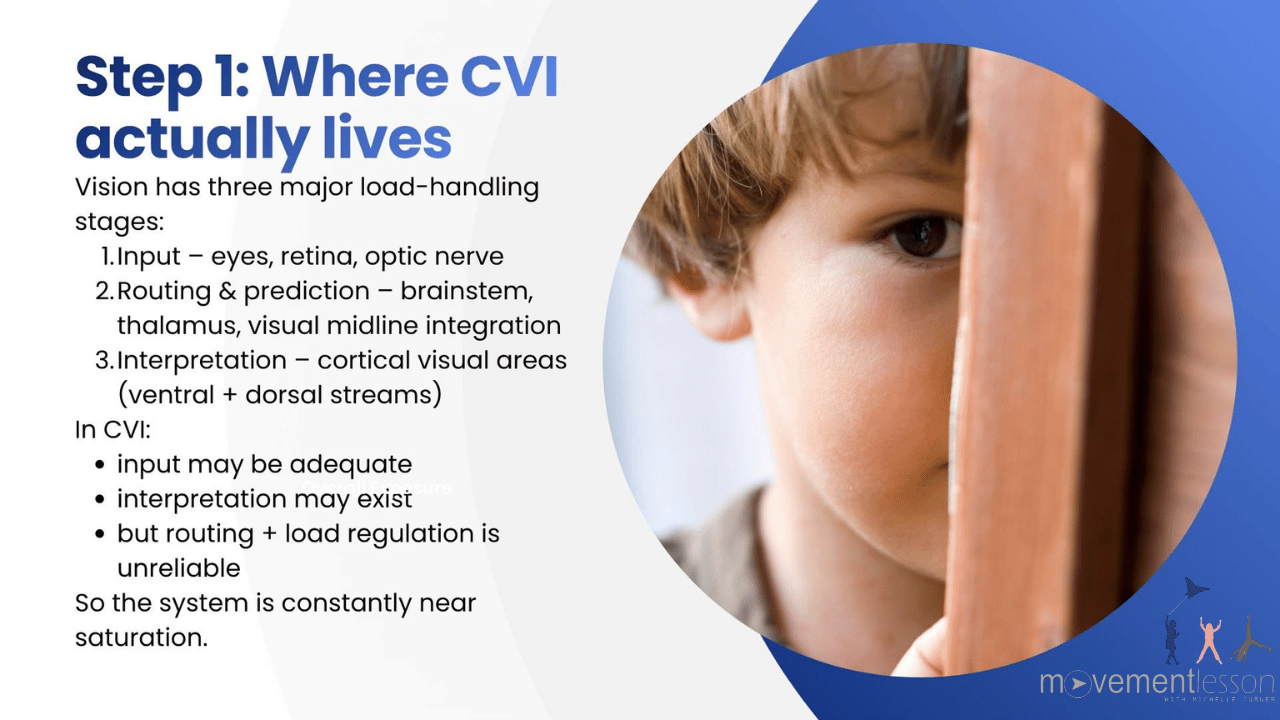
II. VISUAL DEVELOPMENT IS DEVELOPMENT
This should probably be one of the strongest statements in the framework.
Turner Vision does not position vision as something developing independently while the body develops alongside it.
Visual organization participates in the developmental organization itself.
Therefore, when visual development does not organize appropriately, the consequence may extend beyond “poor vision.”
It may affect the developmental organization required for later functions.
This is why the framework must connect:
Eyes  hands feet body gravity environment
hands feet body gravity environmentrather than dividing them into unrelated developmental categories.
III. EARLY VISUAL ORGANIZATION
The earliest stage establishes the child's developing relationship with visual information.
The questions are not yet about reading an eye chart or identifying objects.
We are observing the emergence and organization of visual function.
Relevant Turner observations include such things as:
-
response to visual stimulus
-
each eye individually
-
the relationship between the two eyes
-
following
-
head/eye relationship
-
right/left differences
-
visual attention and response
-
changes produced by position and movement
The important distinction is:
Seeing something is not yet organized functional vision.
IV. BINOCULAR ORGANIZATION
The two eyes must increasingly become available as an organized relationship.
This is more than establishing that two functioning eyes exist.
The assessment needs to distinguish:
right eye → left eye → right/left relationship → eyes functioning together
This is where asymmetry becomes significant.
Does visual function remain equivalent when approached from the right versus the left?
Does one eye dominate?
Does the child lose organization under particular developmental conditions?
Does visual behavior change when the head or body changes?
These differences begin telling us where stress may exist.
V. CONVERGENCE
This needs its own major developmental section.
And we should preserve the timing you've corrected me on:
Awake convergence develops at approximately 4½ months from binocular organization.
Convergence cannot be reduced in Turner Vision to an ocular exercise or simply “bringing the eyes inward.”
It is part of a much larger developmental organization toward center.
The developmental relationship
The eyes begin coming together.
The hands come together.
The feet come together.
And eventually:
hands + feet meet at center.
This is why your distinction is so important:
Grabbing the feet—not grabbing a foot.
Grabbing one foot can produce an apparent milestone.
Bringing both feet together, with the hands meeting them, reveals a different developmental organization.
Visual convergence, fine motor organization, gross motor organization, and spatial organization are participating in the development of center.
VI. DEVELOPMENTAL MIDLINE
This needs to precede any emphasis on “crossing midline.”
The child cannot functionally cross a developmental center that has not first become organized.
So:
Develop center → organize midline → move through midline → cross midline
That makes developmental midline much more than an imaginary line drawn vertically through the body.
It is an organized developmental relationship.
And this is where ocular differences become extremely consequential.
For example, you've specifically identified esotropia in relation to midline interruption.
Therefore, a visible ocular issue cannot simply be filed under “vision” while a therapist separately works on reaching, rolling, sitting, or crossing midline.
Those findings may belong to the same developmental stress.
VII. HANDS + FEET + EYES: CENTER ORGANIZATION
I would give this an entire visual panel in the eventual graphic.
The observable event
Eyes converge.
Hands come together.
Feet come together.
Hands meet feet.
Hands come together.
Feet come together.
Hands meet feet.
The significance is not merely that the child has learned to grab their feet.
The child is organizing multiple developmental systems around center.
This provides an extremely understandable example for parents because they can actually see the organization occurring.
And importantly, it demonstrates why Turner does not isolate:
vision / fine motor / gross motor
as though development independently constructs three different systems.
VIII. FROM CENTER TO WEIGHT TRANSFER
Once center and midline organization become available, development can increasingly organize movement away from center and across the body.
Weight transfer becomes critical.
And this is another place where Turner Vision and Movement Lesson cannot be separated artificially.
You've identified early ocular muscle demonstration as taking away from weight transfer.
That matters because weakness or displacement in weight transfer affects subsequent developmental milestones.
Therefore, what appears to be a gross-motor problem may contain significant visual organizational stress.
The intervention question cannot simply be:
“How do we teach this child to perform the missing milestone?”
We have to ask:
“What organization required for that milestone isn't available?”
IX. INDEPENDENT SITTING: THE ORGANIZATION BECOMES VERTICAL
This is one of the relationships I think deserves a very strong graphic.
The organization developed horizontally doesn't disappear when the child sits.
The child must now maintain and use that organization vertically.
Your description is particularly important:
Independent sitting is essentially the same function expressed in vertical positioning.
The spatial relationship has now changed.
The child has to organize themselves, their vision, center, weight transfer, and the environment from this new orientation.
So sitting isn't simply:
“Baby can remain upright without falling.”
It represents another level of functional organization.
Part 2 coming soon!
Click HERE to learn more today!