
Cortical Visual Assessment
Jun 25, 2026
Movement Lesson CVI Scale
Cortical Visual Assessment
Most CVI assessments ask:
"How much can the child see?"
We ask a different question:
"How does the visual system fail under load?"
When we began analyzing CVI through a functional movement and systems framework, a pattern emerged. Vision doesn't typically fail randomly. It fails through a predictable cascade.
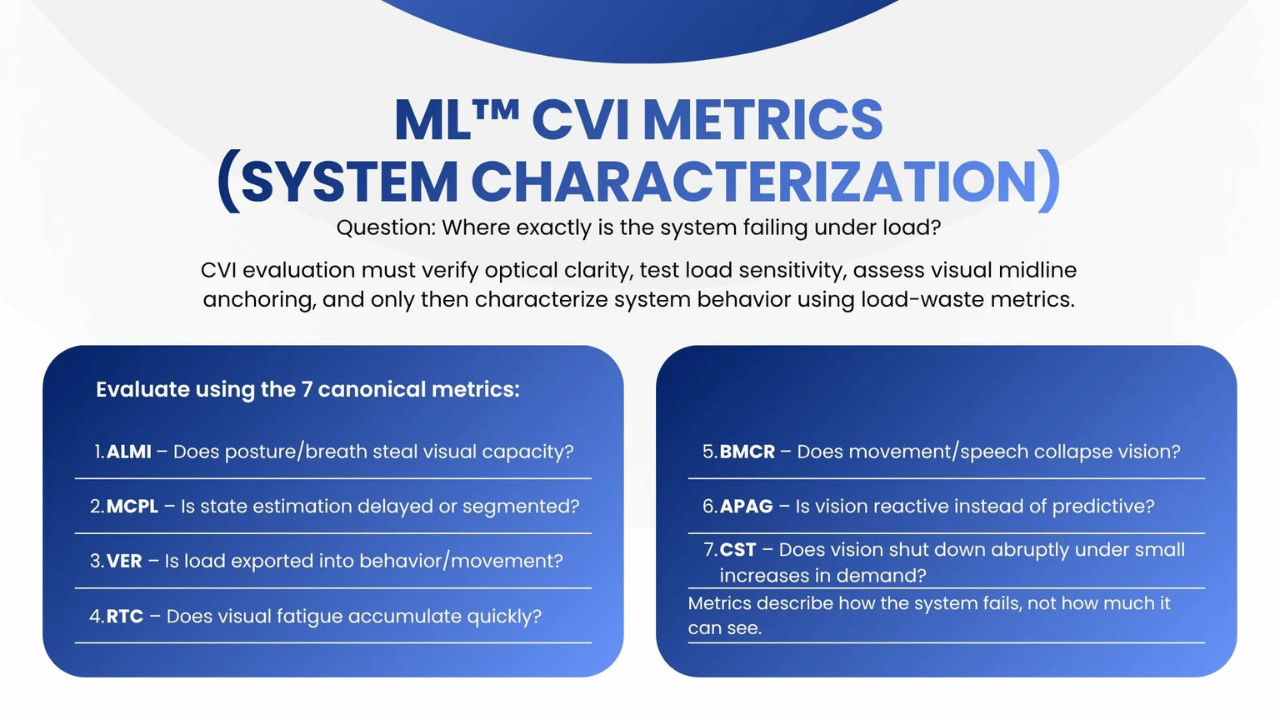
 ALMI – Axial Load Modulation Index
Can the body support vision?
If not...
 MCPL – Midline Coherence Phase Lag
Can vision organize around the visual midline?
If not...
APAG – Anticipatory Postural Adjustment GainCan the system predict what is coming next?
If not...
VER – Variance Export RatioVisual load gets pushed into movement, behavior, and emotional regulation.
BMCR – Breath-Movement Coupling RatioSpeech, movement, and vision begin competing for the same resources.
RTC – Recovery Time ConstantVisual waste accumulates faster than it can be cleared.
CST – Constraint Saturation ThresholdThe system reaches capacity and shuts down.
What appears to be "behavior," "inattention," or "lack of motivation" may actually be a visual system attempting to survive an increasing load.
This shifts the conversation away from visual acuity alone and toward something more important:
How does the system regulate load, prediction, recovery, and performance across real-world environments?
The future of CVI assessment isn't simply measuring what a child can see.