
How Are You Moving?
Jul 28, 2026

Now I just golfed with this young man, and he got a Movement lesson after his game. I can’t wait to show you the improvements.
Using a short clip (about 2.1 seconds) filmed from a distance, there is still quite a bit we can observe from an organizational movement perspective.
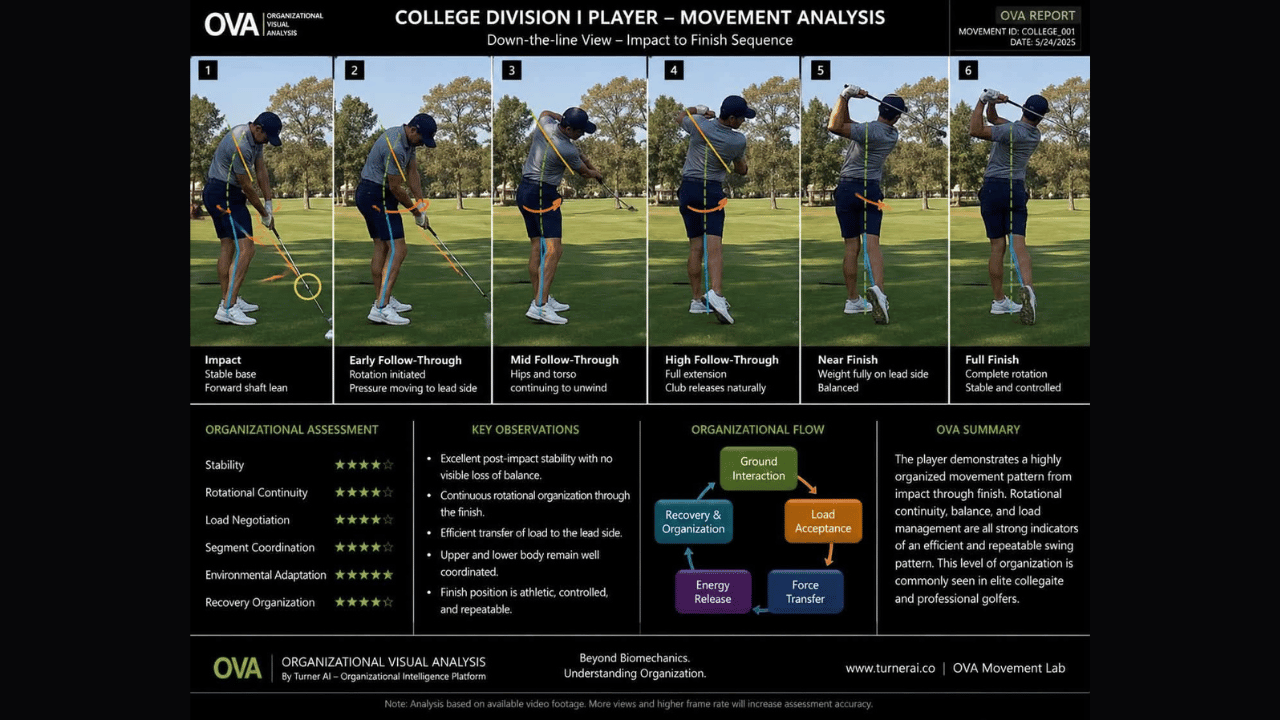
OVA Movement Analysis
Subject: NCAA Division I Golfer
Observation: Follow-through phase (impact is not fully visible)
1. Organizational Stability — Excellent
The first thing I notice is stability after force production.
Many golfers can generate speed.
Far fewer organize themselves well after impact.
This player demonstrates:
* Stable balance
* No obvious recovery step
* Controlled finish
* No collapse through the trunk
This suggests that the swing is being organized rather than simply powered.
2. Rotational Continuity — Very Good
Looking at the sequence:
* Rotation continues through the finish rather than stopping abruptly.
* The torso continues to unwind naturally.
* The club finishes around the body without appearing forced.
From your terminology, I would describe this as:
Rotation is allowed to complete its organizational task.
There doesn’t appear to be an abrupt braking strategy.
3. Ground Interaction
One thing I like:
The player does not appear to fight the ground.
Instead:
* force is accepted,
* transferred,
* and released.
That’s different from simply “pushing hard.”
It indicates efficient load negotiation.
4. Load Negotiation
This is probably my favorite part.
After impact the body continues reorganizing.
The golfer isn’t “holding a pose.”
The finish is actually the body negotiating the remaining momentum.
That tells me:
* efficient deceleration
* continuous organization
* no obvious emergency compensation
5. Segment Coordination
Although the camera is distant, I observe:
* pelvis
* trunk
* shoulders
* arms
* club
remaining synchronized during the finish.
Nothing appears disconnected.
6. Environmental Organization
The player appears comfortable with the environment.
No hesitation.
No balance corrections.
No obvious reaction to uneven footing.
The environment becomes part of the movement rather than something being resisted.
To make this into a true Turner AI OVA report, I’d want:
* Full swing from address
* Down-the-line view
* Face-on view
* 120–240 fps if possible
* Three to five swings
That would allow us to compute organizational measures across the entire movement.
My OVA Summary
Instead of saying: “His elbow is here.” or “His club is on plane.”
I’d summarize the clip this way:
Organizational Strengths
* Excellent post-impact stability.
* Continuous rotational organization through the finish.
* Efficient load transfer.
* Balanced deceleration.
* Strong environmental adaptation.
* No obvious loss of organizational continuity after impact.
One suggestion for OVA
This clip also reinforced something we’ve discussed.
Traditional golf analysis asks:
What is the swing doing?
OVA asks:
How well is the person organizing themselves while producing the swing?
That distinction is subtle but important. It shifts the analysis from isolated positions to the quality of the movement system as a whole.
As we build OVA, I’d also like to introduce a set of organizational metrics rather than conventional golf metrics. For example:
* Rotational Continuity Index
* Load Negotiation Efficiency
* Organizational Stability
* Environmental Adaptation
* Recovery Organization
* Movement Economy
Those metrics wouldn’t be limited to golf—they could be applied to surgery, rehabilitation, robotics, manufacturing, or any domain where coordinated movement through an environment is central. I think that’s one of the aspects that could make OVA a distinctive capability within Turner AI.
Click Here to learn more about Movement Lesson and Turner AI.