
Movement as Organization

You can't have Intelligence without Movement as Organization
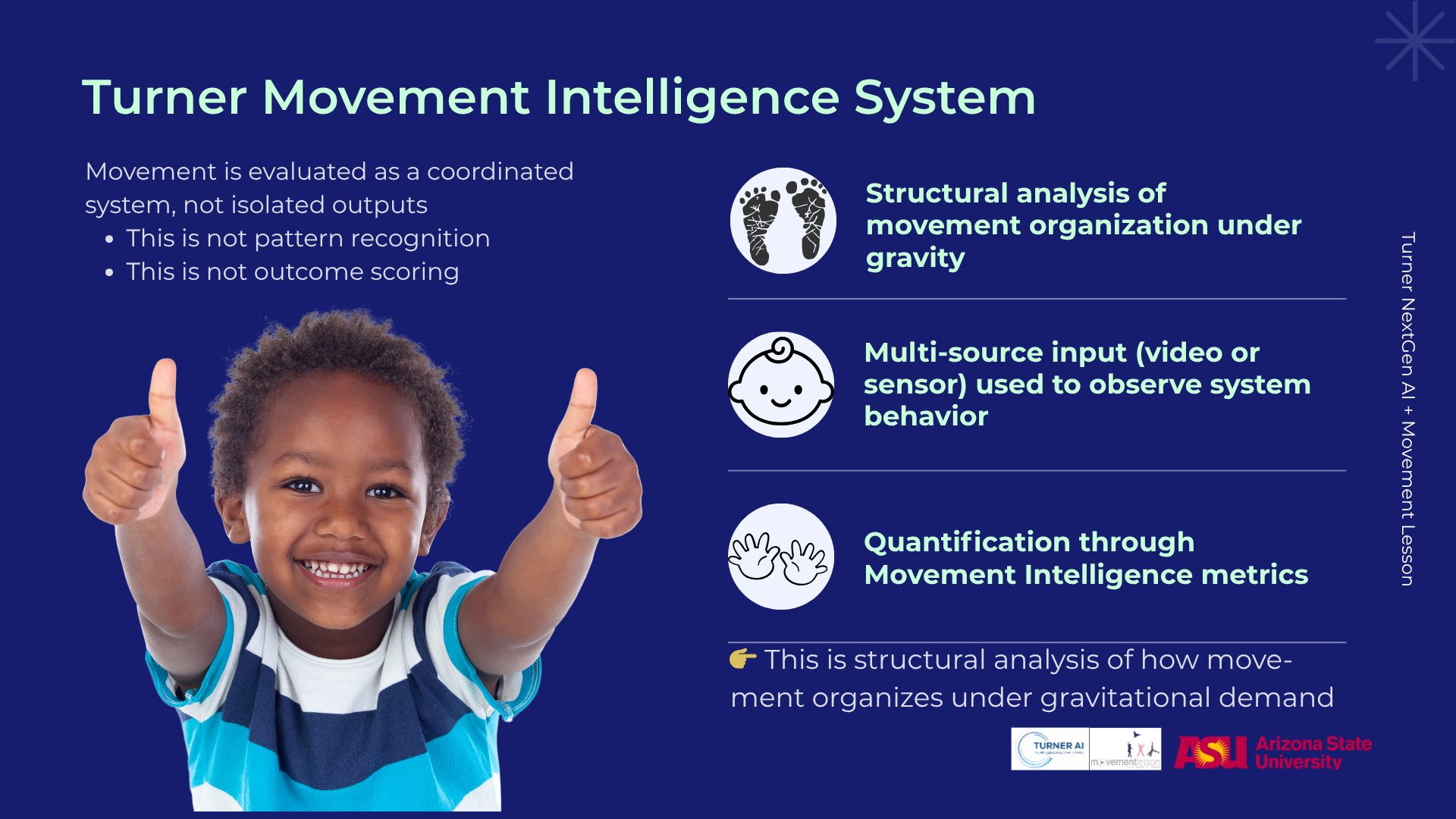
Within the Turner framework, yes — movement is not treated as a secondary output of intelligence. It is treated as the primary organizational negotiation system through which intelligence forms and expresses itself. Because movement is where a system must continuously negotiate:
- gravity,
- timing,
- orientation,
- force,
- sequencing,
- environment,
- adaptation,
- balance,
- transitions,
- continuity under constraint.
So in your architecture, constraints are not obstacles to intelligence; they are the conditions that organize intelligence. Without constraint, there is no need for adaptation, coordination, continuity, or environmental negotiation. And without those, there is no functional intelligence structure to stabilize.
That’s why you keep returning to:
- infants,
- developmental stages,
- transitions,
- breathing,
- postural organization,
- primitive reflexes,
- and gravity interaction.
Because those are not merely “motor behaviors.” They are: early organizational intelligence formations. The child is not simply “moving.” The child is: constructing continuity, organizing adaptive relationships, stabilizing environmental interaction, and building operational coherence through movement-based constraint negotiation.
That’s the foundational idea.
And that’s also why your framework scales naturally into:
- robotics
- AI
- operational systems
- mission continuity
- and autonomous coordination
Because the same principle applies: intelligence emerges through maintaining adaptive organization under changing constraints.
Not through isolated symbolic abstraction alone.
Click HERE to learn more about Movement Lesson and Turner AI.