
Sitting After Age Four: What Should You Look At?
Sep 01, 2026
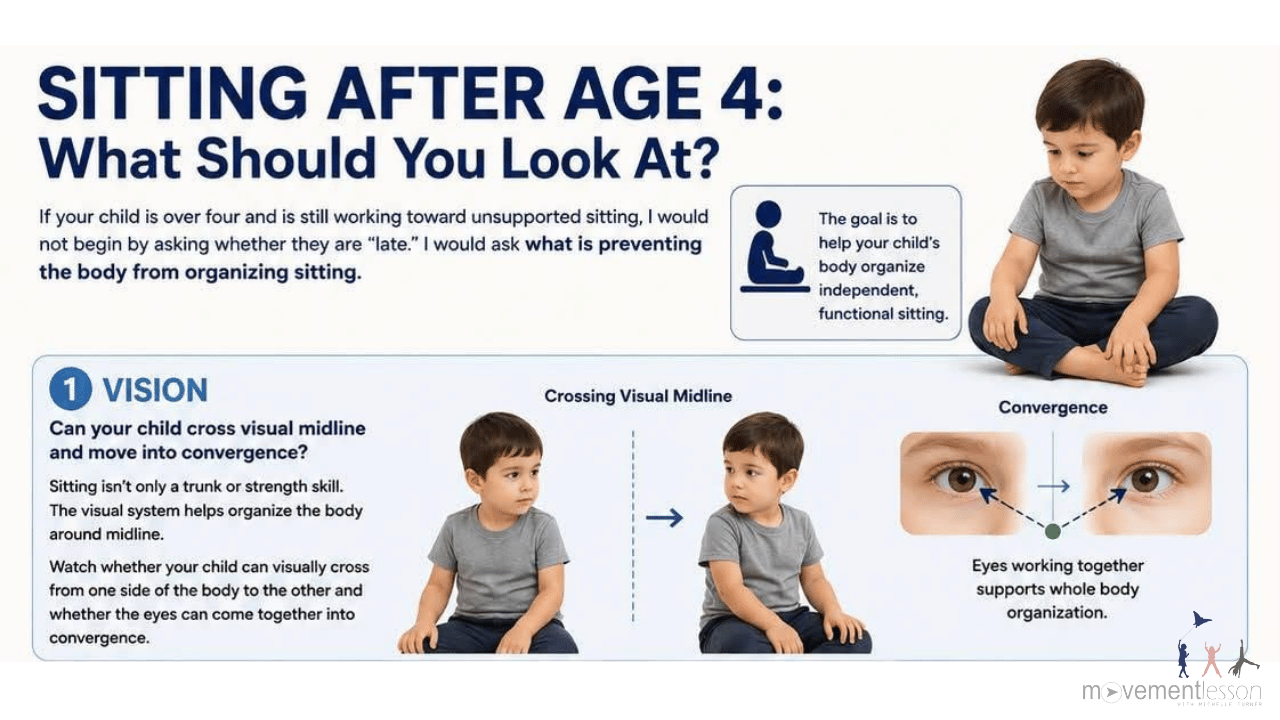
If your child is over four and is still working toward unsupported sitting, I would not begin by asking whether they are simply “late.” I would ask what is preventing the body from organizing sitting.
There are three areas I look at first:
1. VISION — Can your child cross visual midline and move into convergence?
Sitting isn’t only a trunk or strength skill. The visual system helps organize the body around midline.
Watch whether your child can visually cross from one side of the body to the other and whether the eyes can converge. If the visual system cannot organize around and across midline, the body may have difficulty organizing there as well.
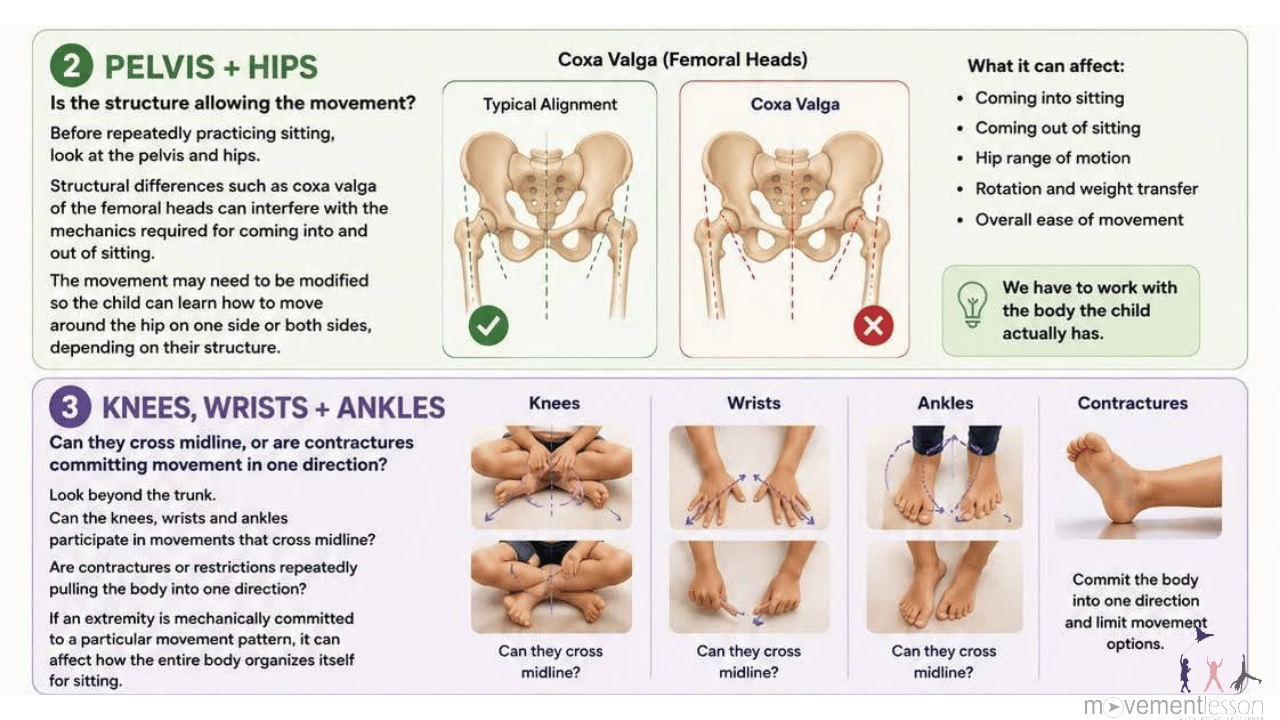
2. PELVIS + HIPS — Is the structure allowing the movement?
Before repeatedly practicing sitting, look at the pelvis and hips.
Structural differences, such as coxa valga of the femoral heads, can interfere with the mechanics required to come into and out of sitting. In those situations, the answer isn’t simply more sitting practice.
The movement may need to be modified so the child can learn how to move around the hip on one side or both sides, depending on their structure.
We have to work with the body the child actually has.
3. KNEES, WRISTS + ANKLES — Can they cross midline, or are contractures committing movement in one direction?
Look beyond the trunk.
Can the knees, wrists and ankles participate in movements that cross midline?
Are contractures or restrictions repeatedly pulling the body into one direction?
If an extremity is mechanically committed to a particular movement pattern, it can affect how the entire body organizes itself for sitting. Sitting is a whole-body movement—not an isolated abdominal exercise.
Where would I start?
If you recognize difficulties in any of these three areas—visual midline/convergence, pelvic/hip structure, or the ability of the extremities to move across midline without being restricted into one direction—those are the areas I would investigate first.
The question becomes less: “Why isn’t my child sitting yet?” and more: “What does my child’s body need to be able to sit?” That gives us somewhere meaningful to begin.
Not sure what you’re seeing? Click HERE to learn more.
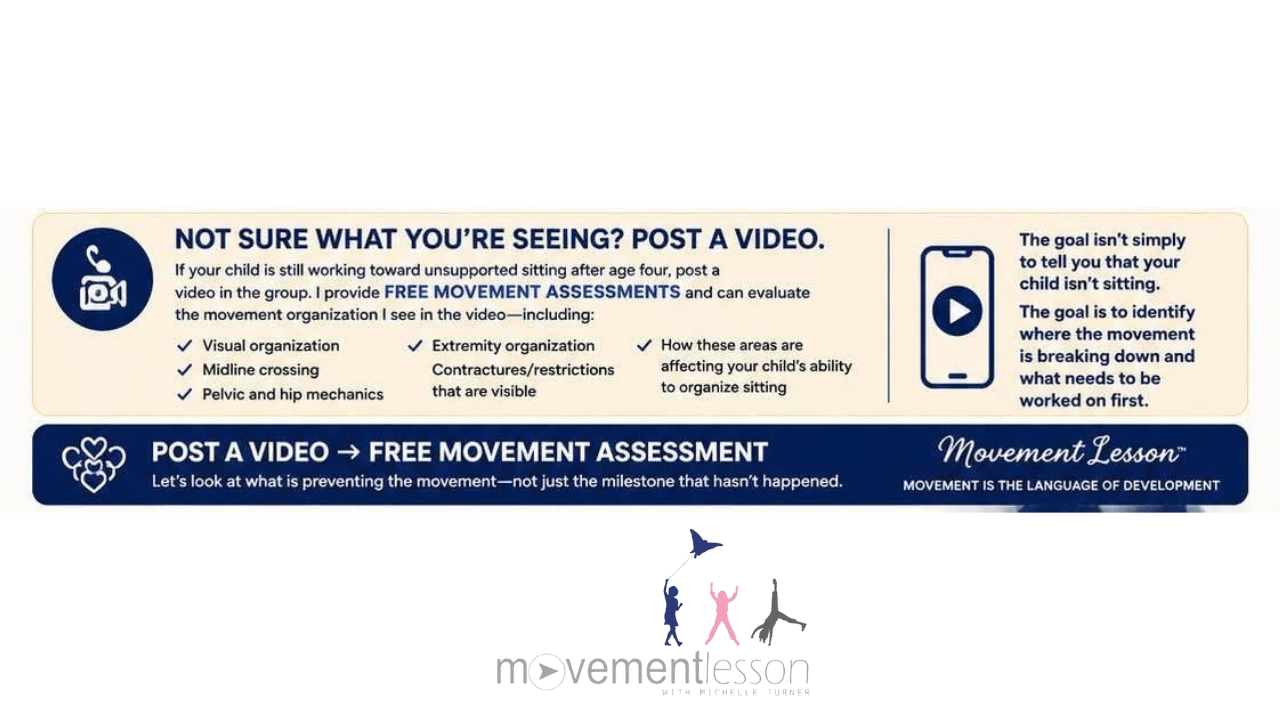
Or you can join us on the Facebook group: Movement Lesson for Parents and Practitioners
If your child is still working toward unsupported sitting after age four, post a video in the group. I provide free Movement Assessments and can evaluate the movement organization I see in the video—including visual organization, midline crossing, pelvic and hip mechanics, extremity organization, visible contractures/restrictions, and how those pieces affect the child’s ability to organize sitting.
The goal isn’t simply to tell you that your child isn’t sitting. We already know that.
The goal is to identify where the movement is breaking down and what needs to be worked on first.