
The Difference Between Coming to Midline and Crossing Midline
Jun 30, 2026
Independent Sitting:
The Difference Between Coming to Midline and Crossing Midline
When parents hear the phrase "independent sitting," they often think it simply means their child can sit without falling over. From a developmental perspective, however, independent sitting represents something much more significant. It is one of the first major indicators that the nervous system has organized itself around a stable midline.
A child who has developed a responsive pelvis and established a functional pubic bone strike is no longer relying on the floor, furniture, or their hands for stability. Instead, their body has learned to organize itself through its own center. This stable foundation allows movement to emerge naturally rather than being used to prevent falling.
One of the most important signs of this organization is the ability to move through midline rather than simply to midline.
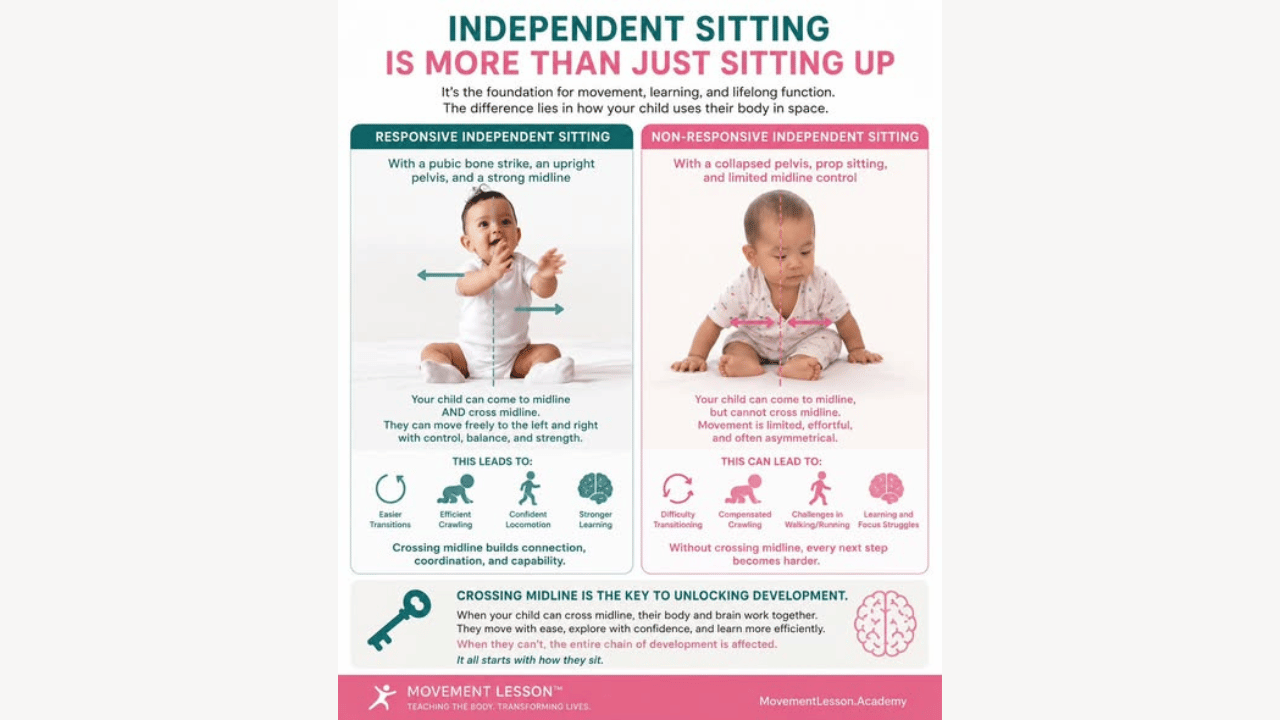
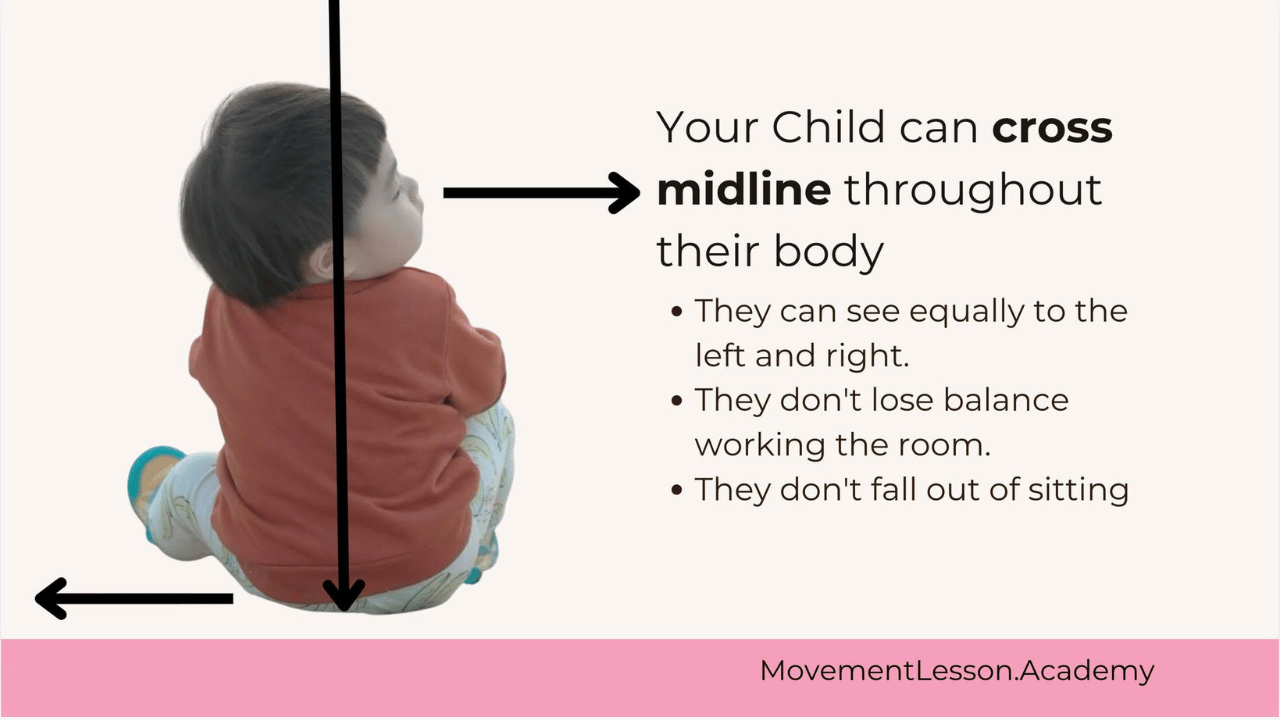
A child with a responsive sitting pattern can rotate their trunk, shift their weight, reach across their body, retrieve toys from either side, and return to an upright position without losing balance. They are no longer fixed over their center—they can organize movement around it. Their pelvis provides a stable platform while the trunk, arms, head, and eyes begin working independently of one another. This is the beginning of true transitional movement.
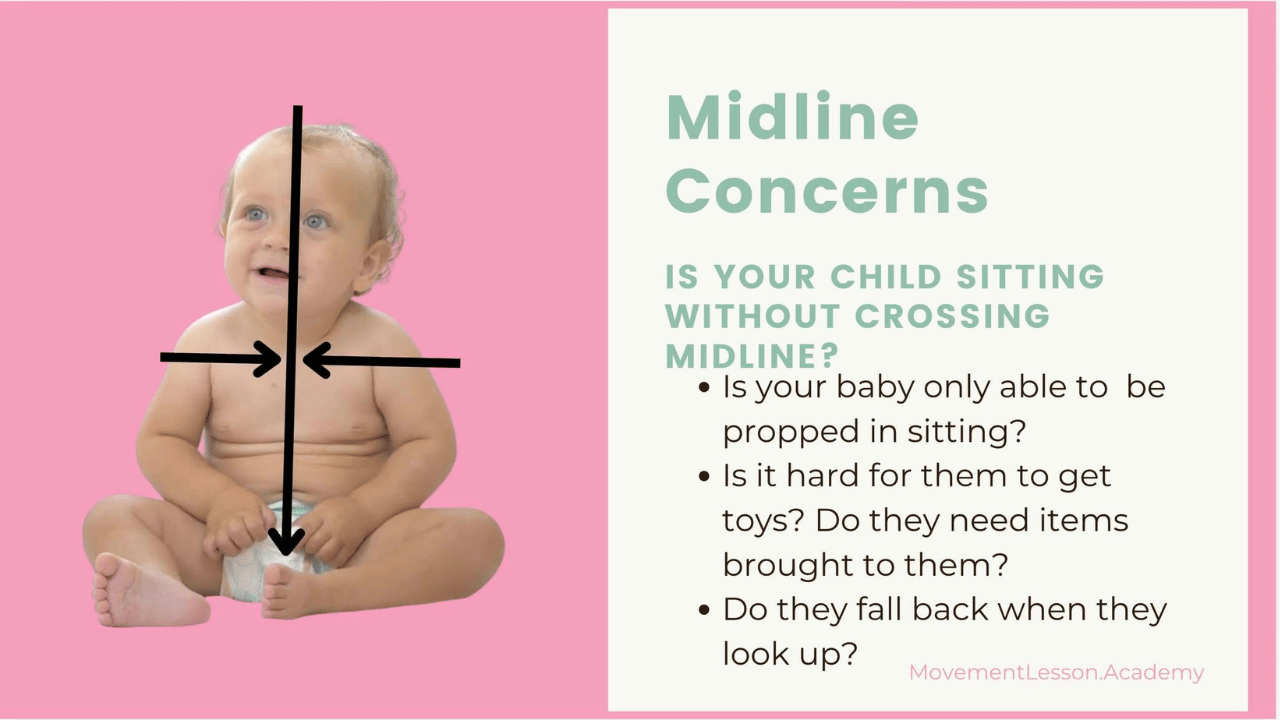
In contrast, a child with a collapsed pelvis or who depends on prop sitting often appears stable, but that stability comes from external support rather than internal organization. They may be able to bring their hands to the center of their body, but they struggle to move beyond it. As they reach across midline, their balance is lost. Looking up may cause them to fall backward. Turning to one side often requires repositioning their entire body instead of rotating through the trunk.
This difference may seem subtle, but its developmental consequences are profound.
Crossing midline is the foundation for every major transitional milestone that follows.
When children can organize movement through their center, they begin transitioning smoothly between sitting, side sitting, hands-and-knees, crawling, kneeling, pulling to stand, cruising, and eventually walking. Each new milestone builds upon the previous one because the nervous system has learned how to transfer weight, rotate, and reorganize itself while maintaining stability.
When crossing midline is unavailable, those same transitions become expensive. Children frequently compensate by avoiding rotation, pivoting instead of transitioning, belly crawling rather than moving through hands-and-knees, pushing backward, using both hands together instead of independently, or relying on environmental supports to maintain balance. They may still achieve milestones, but the movement is organized through compensation rather than efficient control.
This is why observing independent sitting is about far more than asking, "Can my child sit?"
The more important question is:
Can they organize movement through their center without losing stability?
Development is not measured simply by whether a milestone has been reached. It is measured by the quality of organization that allows the next milestone to emerge.
-
A stable pelvis creates a stable midline.
-
A stable midline allows crossing.
-
Crossing creates transition.
-
Transition creates locomotion.
-
Locomotion creates exploration.
And exploration becomes the foundation for learning, interaction, and adaptive development.
Independent sitting is not the destination.
It is the bridge that allows a child to move confidently into every stage that follows.
Click HERE to learn more about Independent Sitting.