
The Mathematics of Midline
Apr 28, 2026

As you know, I've created my own Turner AI to do real-time video image capture. I'm teaching a computer how to see movement as I do. As we are taught that human motion is about pieces and parts of a complex unit, human movement is about function and opposing gravity.
The Mathematical Framework of Midlines: Buoyancy, Rotation & the Birthing Equation
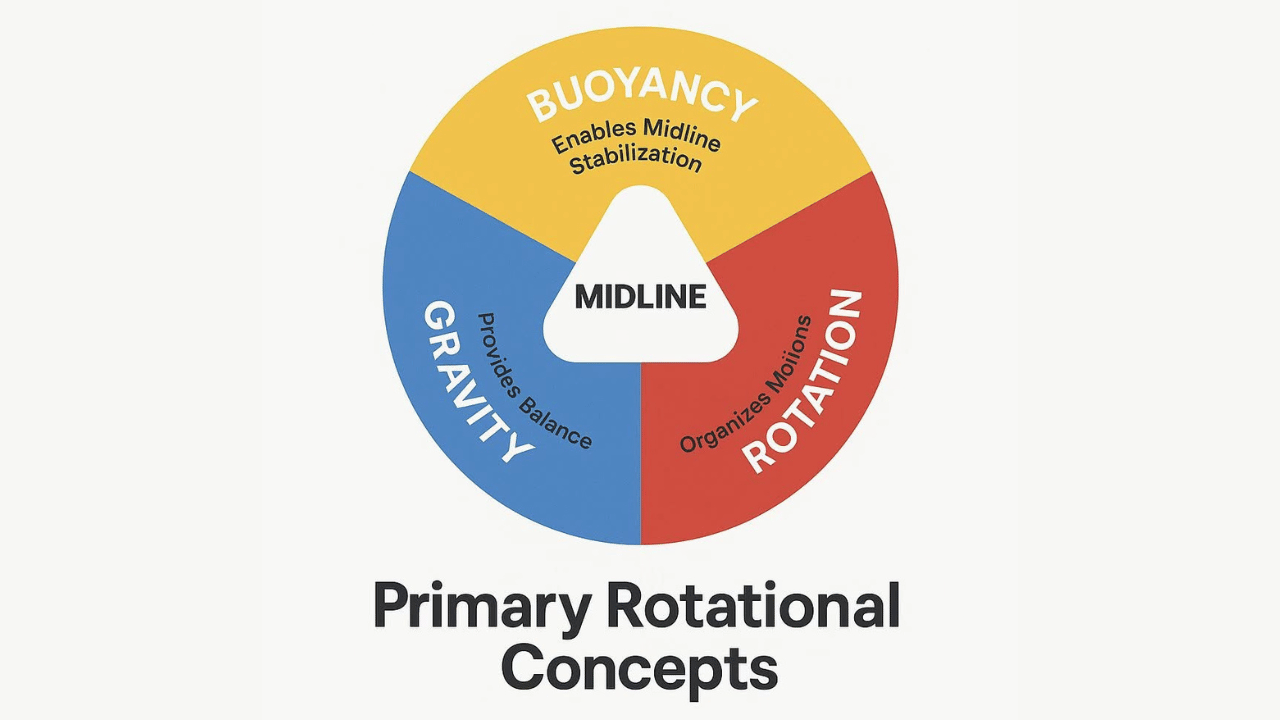
To do so, we need to have three key features:
-
Rotation: Rotation creates the torque and counter-torque required to assemble and maintain the midline through spiraling opposition.
-
Buoyancy: The body's ability to distribute internal force to float within gravity, not collapse into it.
-
Gravity: Gravity is not a pull but a binding resistance. Midline forms when the body binds into gravity with equal and oppositional movement.
In our biomechanics for simple to complex midlines to present.
Here are some of the mathematical calculations that go into the processes of the human body. Now we can measure them beyond guessing and weight, and see early responses from our children.
Midlines are dynamic functions of buoyancy and rotation, and how this system becomes organized (or breaks down) during the birthing process. This is structured so it can double as foundational copy for scientific papers, Turner AI architecture, or advanced training.
Core Concept: Midlines as Dynamic Rotational Boundaries
A midline is not a static anatomical marker — it is a rotational axis of equilibrium that defines the body's ability to:
-
Divide and coordinate hemispheric function (left/right, top/bottom, front/back)
-
Transfer force across the body's internal buoyancy systems
-
Sustain vertical development against gravity
It is governed by functional opposition: for every rotation, there must be an equal and oppositional counterbalance to maintain rotational nesting.
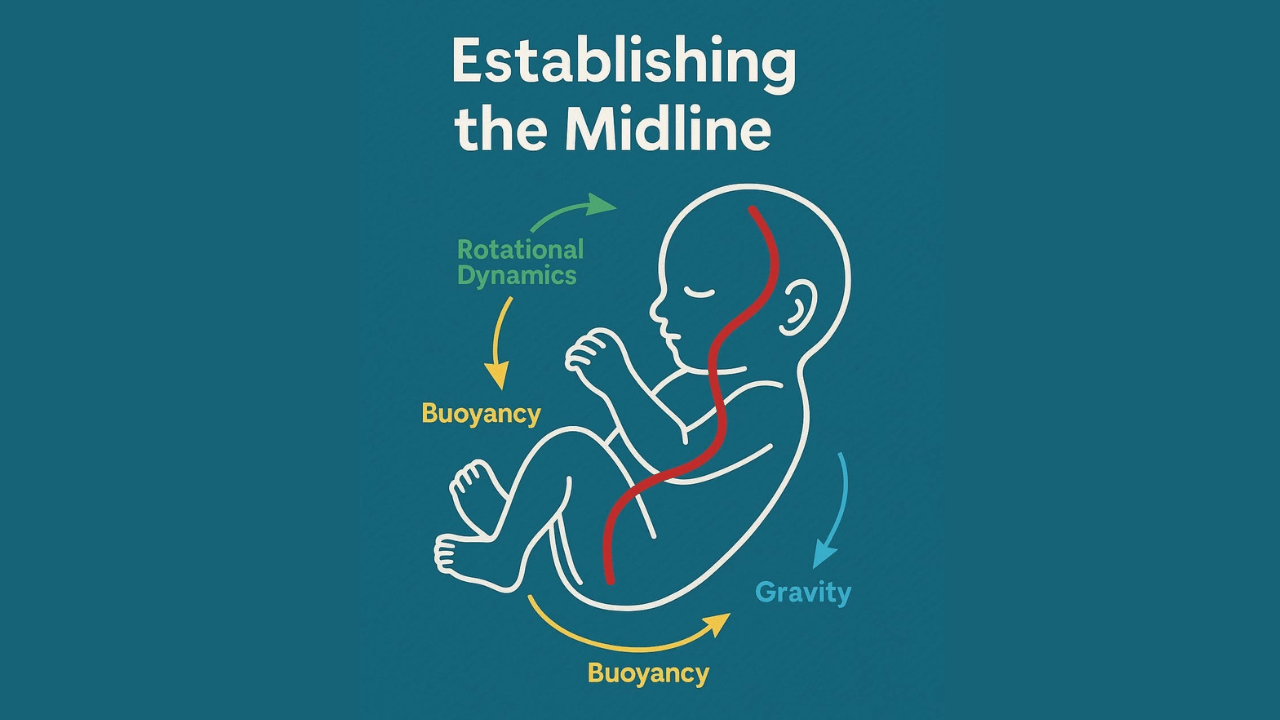
Stage I: Formation of Midlines During the Birthing Process
In utero, the baby develops in a buoyant, low-gravity environment. But true midline structuring begins during the descent through the birth canal — a rotational journey where gravitational forces introduce organized pressure, torque, and counter-torque.
Key Forces at Play:
Fm=(Br⋅Rs)⋅G
Where:
-
Fm: Midline force organization
-
Br: Buoyancy responsiveness (fluid-organ shift around gravity vector)
-
Rs: Rotational stability coefficient (core opposition via joints, sutures, fascial tethers)
-
G: Local gravitational force (Earth's vector, increases during descent)
As the baby rotates through the pelvic inlet/outlet, cranial sutures, spinal flexion, shoulder internal/external rotation, and pelvic sacral mobilization must all synchronize.
If buoyancy (Br) is poorly organized — for example, due to retained amniotic fluid or poor lung compression — the child's internal scaffolding never reaches a "rotationally reactive" state.
Stage II: Mathematical Breakdown of Midline Complications
Breakdown occurs when rotational symmetry or buoyant counterforce becomes asymmetrical, delayed, or collapsed.
Common Fail Points:
-
Asymmetrical buoyancy:
If lung compression or fluid shifts during birth are uneven, internal buoyancy cannot organize bilaterally.
ΔB=∣BL−BR∣>ε
Where ε is the midline tolerance threshol, whenn exceeded, one side becomes hypertonic or hypotonic.
-
Rotational Inertia Without Opposition:
τ=I⋅α
Where:
-
τ: Torque
-
I: Moment of inertia
-
α: Angular acceleration
Without full rotational nesting (especially in the occiput, sacrum, and clavicle), torque becomes excessive and non-transferable, leading to conditions like torticollis or pelvic tilt.
-
Midline collapse = critical divergence:
Fc=m⋅(g⋅Rs⋅Br)→0
When any one of these variables collapses — often via cesarean birth (no rotation), poor breath compression (no buoyancy), or hypotonia (no mass engagement) — midline becomes a non-functional divider. The child cannot perform symmetrical reaching, eye convergence, or weight-bearing without compensation.
Stage III: Turner AI's Diagnostic Lens
Turner AI calculates rotational imbalance using video-tracked joint alignment and symmetry vectors, then overlays midline failure zones using:
Midline Integrity Index (MII):
MII=(Rs⋅Br)left(Rs⋅Br)right
A perfectly functioning midline will yield an MII ≈ 1.0
Deviation > ±0.15 = risk of movement-based disorder
Deviation > ±0.15 = risk of movement-based disorder
Conclusion: Why Midline is a Mathematical Truth
Midline is not just anatomical — it's a gravitational algorithm.
Its breakdown is measurable by:
Its breakdown is measurable by:
-
Angular torque loss
-
Buoyancy asymmetry
-
Rotational discontinuity
By combining Turner Equations of mass, gravity, and rotation, we can evaluate the origin point of developmental failure — beginning with how midline is built (or broken) during the first breath and the birth spiral.
Click HERE to learn more about Movement Lesson today!